Wood Testing Equipment: Portable, Accurate Solutions for Strength Grading and Quality Control in the Timber Industry
From Portable Lumber Grader to Resonance Lumber Grader – Ensuring Structural Compliance with EN-338 and EUROCODE 338 Standards
Executive Summary
Wood testing is not merely a procedural formality but a critical step for safety and cost efficiency. Wood used in building construction, bridges, or furniture must withstand intended loads. Testing helps avoid losses from material failure during production. Two main types of equipment are widely used: Portable Lumber Grader, which classifies wood strength according to EN-338 based on Modulus of Elasticity (MOE) and specific gravity, taking about 1 second per piece; and Resonance Lumber Grader, which uses longitudinal vibration to estimate dynamic MOE, supports logs and lumber up to 12 meters, with frequency accuracy of ±2 Hz. Proper selection of testing tools ensures accurate results and compliance with industry standards.

The Challenge
- !
Deployment of Portable Lumber Grader and Resonance Lumber Grader for On-Site and Laboratory Wood Strength Testing
Wood testing equipment serves multiple functions in industry: determining material quality to ensure consistent production output, supporting construction standards by verifying material strength, and reducing product damage risk by preventing use of out-of-specification wood. The Portable Lumber Grader classifies both broadleaf (deciduous) and conifer wood including poplar, with results based on MOE and density. The Resonance Lumber Grader works by inputting wood length and species, then automatically calculates density and provides grading according to EUROCODE 338, also supporting log grading on a scale of 1 to 10. Both devices enhance production efficiency and maintain material quality standards.
Strategic Approach
- 1
Determine your testing needs first. Moisture meters are suitable for moisture content testing, while Portable Lumber Grader is more appropriate for structural strength classification. Universal Testing Machines (UTM) are comprehensive options for fixed laboratories.
- 2
For field testing or moving locations, choose lightweight, portable devices such as Portable Lumber Grader or Resonance Lumber Grader. For stationary laboratories, a UTM may be a more comprehensive choice.
- 3
Check the standards supported by the device. If your industry follows European standards, ensure the tool supports EN-338 or EUROCODE 338. Standard compliance is essential for validity of test results.
- 4
Place the wood piece on the device. The grader automatically measures Modulus of Elasticity (MOE) and specific gravity. Within approximately 1 second, the tool outputs strength classification according to EN-338 for either broadleaf or conifer wood.
- 5
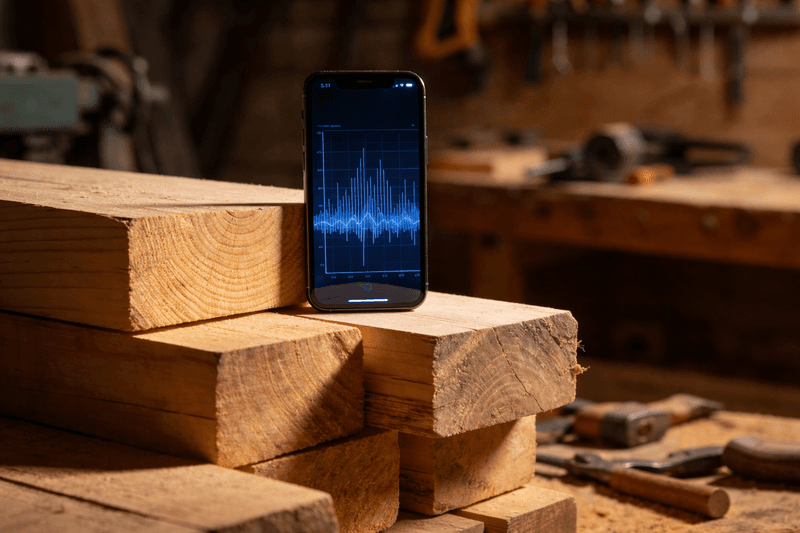
Input wood length (1–12 meters) and species. Use the supplied hammer to excite longitudinal vibration. The Android device with specialized software measures vibration frequency (accuracy ±2 Hz), automatically calculates density and dynamic MOE, and provides grading per EUROCODE 338 (for lumber) or scale 1–10 (for logs).
Business Impact